Learning to watch ourselves...
Margaret WheatleyLearning to watch ourselves and take responsibility for our actions and choices is the only work that leaders need to do at this time.
- Margaret Wheatley
This fish eagle takes pride of place in a large painting that hangs in my lounge. A 10-minute kayak trip from my home takes me to a wooden structure in the reserve next to the water where a pair of fish eagles spend most of the day observing the activity going on around them. I find this a beautiful and appropriate image for the subject of this first building block.
Gattegno’s assertion – ‘Only awareness is educable’ – is the inevitable starting point and overarching theme of Module One.
As you will probably have picked up from the three stories found in the ‘Threads’ section of this website, my teaching methodology was birthed in the turbulence of the struggle against apartheid, at a time when there seemed to be an epidemic of numbness and blindness amongst those with privilege.
My teaching at the GSB and in the corporate world has shown me that a great deal of numbness and blindness still exist today. The images and reports of the whole range of world brutalities is readily available to each of us and, if we offer them our feeling selves, it is almost inevitable that one is hit with a crushing hopelessness. It’s so much easier to numb out feelings. This encourages people to rush around at ever-increasing speeds looking for safety in familiar, repetitive behaviour as they try to create an immediate world of certainty. It becomes important to try to avoid conflict by being in control of situations. From here it is a simple step to assume that one is always correct and go to enormous lengths to protect oneself from doubt and failure through the creation of rational justifications for their behaviour. This means that there is very little opportunity or motivation to do anything more than pay lip service to the idea of personal growth.
The reality is that without awareness, there is hardly any likelihood of meaningful change taking place.
Daniel Goleman expresses the problem very clearly in his introduction to Vital Lies, Simple Truths, when he says:
The range of what we think and do is limited by what we fail to notice. And because we fail to notice that we fail to notice, there is little we can do to change; until we notice how failing to notice shapes our thoughts and deeds.
So, my first challenge is to facilitate a process of Noticing. This starts with the crucial introduction of the concept of the Outer Witness.
The Outer Witness is a curious, generous and non-judgemental part of ourselves who is constantly observing us in action from outside our body. The Outer Witness is very far removed from the Inner Critic, who finds fault (in a variety of recognisable voices from the past) with almost everything that we do. The Outer Witness is interested in what we do and why we do it.
The Rig Veda describes this watching in terms of two birds:
Two birds, close yoked companions. Both share the self-same tree. One eats of the sweet fruit. The other looks on without eating.
There are many ways to practise developing this Outer Witness. Mindfulness is one particularly powerful tool. In recent classes, I have focused attention on how we greet each other based on the TED talk by Dumisani Magadlela.
How much eye and heart contact do you make with others? What levels of (dis)comfort do you feel when greeting others in this way? What would you like to try to do differently?
The process of being more intelligent in the world begins with the development of a strong Outer Witness, and then working to ensure that this Outer Witness is constantly present and alert. This is not an easy process; Outer Witness work is extremely demanding and requires enormous discipline if we are to become aware of the full range of automatic reactions, assumptions and taken-for-granted-beliefs that we have relied on to keep us feeling safe as we sleepwalk through life.
However, discipline and a willingness to become more aware are still not enough! It is so easy to nod our heads in agreement with the ideas being introduced here and think that it is others who make these mistakes. My experience strongly shows that each of us is very unaware of how much we fail to notice. For my sessions, I have designed a range of activities that are designed to increase the perturbation and hold a mirror up to individuals and the group so that they can see these automatic failures to notice. I have to set up each activity carefully so as to create a tense environment with both the content and the persona I take on. At this initial stage, I often take on the role of a dictatorial teacher who encourages competition and certainty.
Student behaviour under this pressure almost always underlines Humberto Maturana's observation that when fear, competition or ambition are present, our knowledge/intelligence is not available to us. The more I push, the more the unhelpful (or unintelligent) behaviour becomes apparent to everyone (with the common exception of the person in the spotlight!).
Once there is a (begrudging) increased awareness of the enormity of the challenge that faces us in interrupting our unhelpful automatic reactions (especially when stressed), we can begin the work of expanding our awareness by focusing on other aspects of our lives.
In concluding this introduction to the fundamental challenge of becoming more aware, I offer the diagram below, which is based on a drawing made by Margaret Wheatley during a programme presented at Schumacher College some years ago. I believe that nearly all of us have spent our lives immersed in an educational and parental framework that seduces us into living solely in the above-the-line paradigm world depicted in the diagram. As a result of our collusion, we are co-opted into a paradigm that has its roots in the seventeenth century and sets us the aim and expectation of becoming perfect machines.
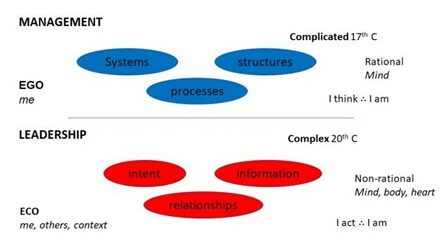
My teaching has been focused on the exploration of complexity and the understanding that the below-the-line terrain is essential territory that must be embraced separately from the complicated above-the-line paradigm. I believe that it is only when we are comfortable and skilled at below-the-line living that we can move productively along a continuum that includes both of these possibilities.
One of my first teaching frustrations occurs when a few students start referring to these concepts as ‘touchy-feely’ or ‘kumbaya stuff’. My outer witness tells me to take a deep breath. If you have had a similar reaction when reading this topic, please watch this TED talk by Dan Ariely, a professor in Behaviour Economics, who covers similar territory (with ‘proper’ gravitas, science and research).